
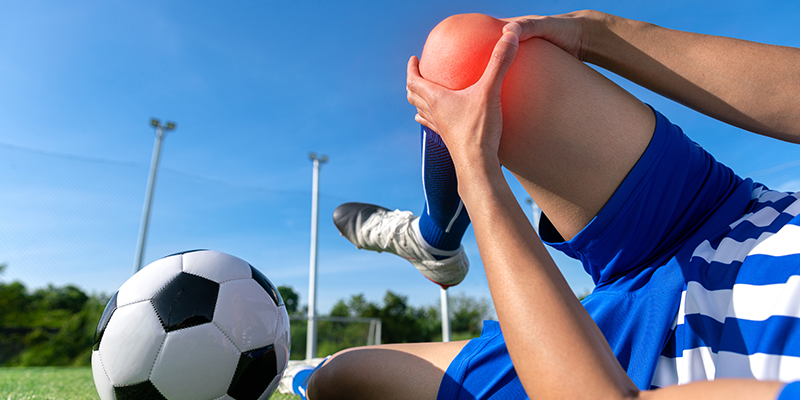
I Felt a Pop in My Knee Playing Soccer”: How to Know If You Tore Your ACL
It’s your typical weekend soccer game. You are sprinting down the field, making a quick cut to dodge a defender, planting your foot firmly on the turf. But as you try to pivot your torso, you feel a violent shifting in the joint accompanied by a sharp, unmistakable sound: an internal “pop” or “click.” Instantly, your knee gives out, you collapse onto the grass, and the pain keeps you from getting back up.
This is the exact way most players experience the single most feared injury in both amateur and professional soccer: an Anterior Cruciate Ligament (ACL) tear. During this action-packed soccer season, local fields are packed with inspired players, but emergency visits to the orthopedic surgeon due to these mechanical accidents are also peaking. If this just happened to you, understanding your symptoms is the critical first step toward your complete joint recovery.
What Is the Anterior Cruciate Ligament and Why Does It Fail on the Field?

A 3D medical illustration showing the exact location of the Anterior Cruciate Ligament (ACL) inside the human knee joint.
The Anterior Cruciate Ligament (ACL) is an extremely strong band of tissue located right in the center of your knee. Its primary job is to act as a natural brake, keeping your shinbone (tibia) from sliding out in front of your thighbone (femur) and providing vital rotational stability when you make sharp, rapid turns.
In soccer, physics can work against your anatomy if your body isn’t fully conditioned. The stress on the joint intensifies when your cleats lock firmly into natural grass or turf. When your foot stays completely anchored while the rest of your body turns with force—a classic non-contact injury mechanism—the torque forces exceed the ligament’s elastic limit, causing a partial or complete tear.
The 4 Clear Symptoms of an ACL Tear
If you recently suffered an injury on the field and suspect an ACL tear, check if you experienced these four key clinical warning signs:
- The Audible “Pop”: Feeling or hearing a distinct cracking or popping sensation deep inside the knee at the exact moment of the pivot.
- Immediate Instability: When trying to stand up or walk, you feel your knee “giving out,” “shifting,” or simply failing to support your weight.
- Severe Swelling (Hemarthrosis): Because the ACL has its own blood supply, tearing it causes internal bleeding that rapidly inflames the knee within the first 2 to 4 hours after the game.
- Loss of Range of Motion: An inability or intolerable pain when attempting to fully bend or straighten your leg.
💡 Keep in Mind: It is crucial to remember that the operating room is never the starting point. The first step is always an accurate, hands-on diagnosis in the office through physical tests and imaging studies. Only then will you know exactly what your knee needs to heal.
The Biggest Danger: “It Doesn’t Hurt Anymore, Can I Play Again?”
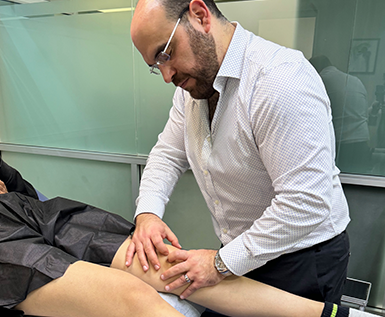
Dr. Alejandro Luna, orthopedic surgeon, performing a physical knee evaluation on a patient at his office in Tijuana.
One of the most common mistakes in recreational soccer happens a few weeks after the injury. Following rest, ice, and anti-inflammatory medication, the swelling goes down and the pain subsides noticeably. Many players assume it was “just a mild sprain” and head back out to the pitch wearing an elastic knee sleeve.
Warning: A torn ACL will never heal on its own. Playing without this vital stabilizer causes your femur to repeatedly grind abnormally against your tibia every time you run or cut. This structural imbalance rapidly destroys your menisci and wears down your cartilage, turning a treatable ligament issue into irreversible, premature joint degeneration (early-onset osteoarthritis).
Timely Diagnosis and Modern Treatments
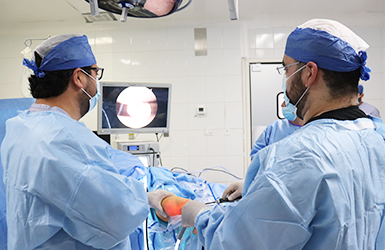
Modern arthroscopy tower and minimally invasive surgical tools inside an operating room for ACL reconstruction.
The proper road to recovery starts with a detailed physical evaluation (using specialized clinical maneuvers like the Lachman test) and is confirmed via an MRI (Magnetic Resonance Imaging) to evaluate the exact status of your menisci and surrounding cartilage.
If your case is severe and a complete tear is confirmed, Dr. Luna specializes in the most advanced and least painful technique available: arthroscopic knee reconstruction surgery. This minimally invasive procedure uses millimeter-sized incisions and high-definition cameras to place a brand-new graft. This drastically reduces post-operative pain and accelerates your physical therapy compared to the open-knee surgeries of the past.
Frequently Asked Questions (FAQ)
1. Can you walk with a torn ACL? Yes. Once the initial swelling goes down (usually after 1 to 2 weeks), many people can walk in a straight line without pain. However, the knee will lack the stability required to safely pivot, run, or cut during impact sports.
2. How long does recovery take after an ACL arthroscopy? Returning to everyday office activities usually takes about 2 to 3 weeks. To return to competitive soccer safely, a progressive sports-specific rehabilitation program alongside focused physical therapy typically spans between 6 to 9 months.
3. What happens if I choose not to get surgery for a torn ligament? If you lead a largely sedentary lifestyle, you might manage through aggressive quad and hamstring strengthening. However, if you are active or want to keep playing soccer, leaving it untreated will cause your knee to remain unstable, tearing your menisci and permanently wearing down your cartilage at an early age.
Schedule an Expert Evaluation
Don’t let the fear of surgery keep you from getting answers. A timely diagnosis is your best tool to protect your leg’s mobility and map out a treatment tailored specifically to you—whether that involves advanced biological therapy, targeted rehabilitation, or state-of-the-art repair.
Receive world-class orthopedic care in the binational region, located just 10 minutes from the San Diego border. Your joint health is our absolute priority!
Alejandro Luna, M.D. — Orthopedic & Trauma Surgeon
🔺 License No.: 7924783 / 10817457
🇺🇸 US Line: (619) 554-2588
🇲🇽 MX Line: +52 (664) 814 3827
🌐 Doctoralia: Book your consultation here
🏥 Location: Office 301, Plaza Lincoln, Paseo de los Héroes 10231-301, Zona Urbana Río Tijuana, Tijuana, B.C., Mexico
🌎 Website: www.dralejandroluna.com